

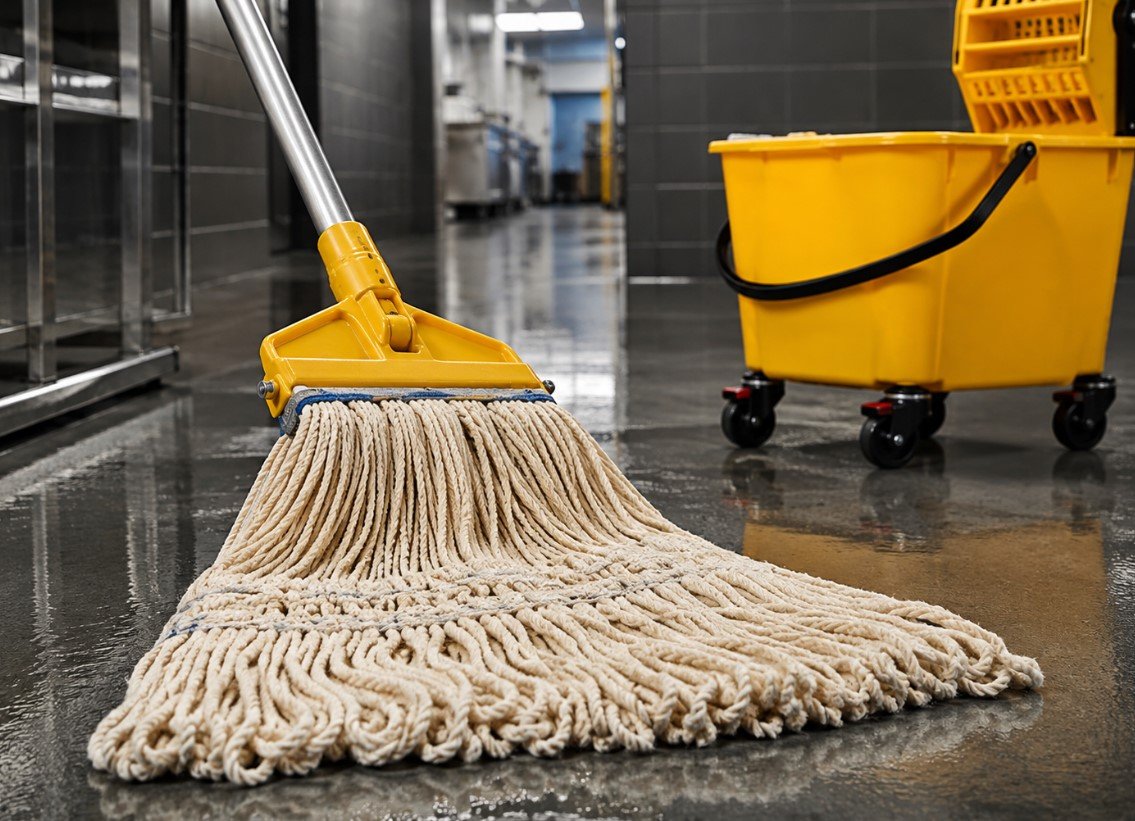
Choosing a wet mop and dry mop begins with the work area rather than the product name. A hotel corridor, hospital ward, restaurant kitchen and factory floor can all require different widths, yarn weights, moisture levels and replacement schedules. This buying guide gives procurement teams a structured method for matching commercial mops to floor type, cleaning frequency and staff workflow. It also explains why a lower purchase price is not always the lowest operating cost when refills wear quickly, handles do not fit or wide frames cannot move through the site.
Start Wet Mop and Dry Mop Selection with the Floor Type
Floor material affects how much moisture, pressure and agitation should be used. Smooth tile can accept routine damp or wet mopping, while wood, laminate or specialty surfaces may require tighter moisture control and approved chemicals. A dry mop is useful for removing abrasive grit before washing. Buyers should obtain the floor-care guidance used by their facility and then select a mop head that supports that procedure instead of assuming every commercial floor can be cleaned with the same tool.
Measure the Cleaning Area Before Choosing Mop Width
Cleaning width should match the amount of open floor and the number of obstacles. A 24 inch dry mop can navigate classrooms and furnished offices, while a 36 inch option offers faster coverage in corridors and halls. A 60 inch dry mop can be productive on warehouse floors but may be awkward around shelving or narrow doors. Measuring the site prevents over-buying wide equipment that staff cannot manoeuvre and under-buying narrow tools that increase labour time.
Select Wet Mop GSM According to Workload
GSM is a practical comparison point for cotton wet mops because it indicates the approximate weight of the mop head. A 400 GSM wet mop is manageable for lighter routine work, 450 GSM balances capacity and handling, and 500 GSM supports greater liquid pickup and broad-area cleaning. Heavier is not automatically better; staff strength, wringer size, drying time and cleaning frequency matter. Trialling one representative unit helps confirm the most suitable working weight before a large order.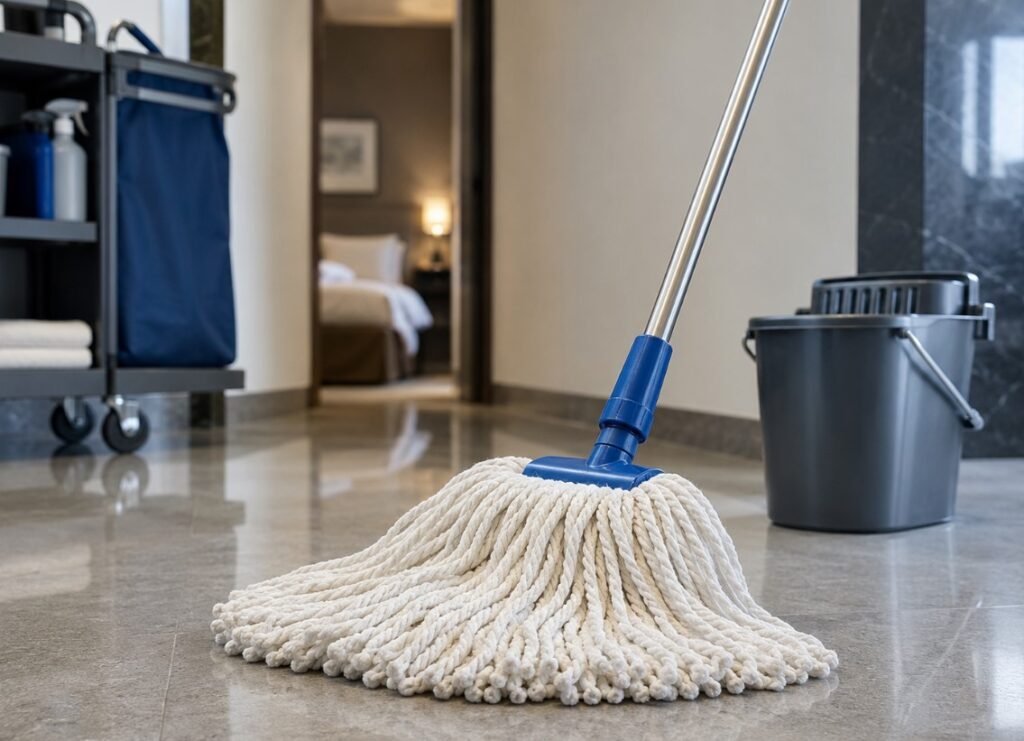
Choose Cotton Wet Mop Construction for the Task
Cotton wet mop construction can include cut-end or looped yarn, different stitching patterns and different attachment systems. Cut-end designs are economical and familiar, while looped options may offer controlled coverage and reduced tangling depending on construction. Buyers should ask how the refill connects to the holder and whether it can be replaced independently. The best choice is the version that performs consistently with the facility’s bucket, wringer, laundering method and staff training.
Use Dry Mop First to Control Loose Soil
Dry mopping before wet cleaning removes particles that might otherwise turn into muddy residue. This is especially useful in entrances, schools, warehouses, retail spaces and offices where dust and grit accumulate throughout the day. The dry mop should move in controlled overlapping passes so debris stays collected at the leading edge. When the refill becomes loaded, it should be cleaned or replaced. A planned two-step sequence often improves appearance while reducing repeated wet passes.
Match Wet Mop Refill to Existing Holders and Buckets
Compatibility errors are a common purchasing problem. A wet mop refill may look suitable but fail to lock into the existing holder or fit inside the wringer basket. Record the connection type, approximate head dimensions and approved handle model before ordering replacements. Where several branches use different systems, procurement should either label specifications clearly or gradually standardise them. Standardisation can simplify stock control, training and emergency replacement when one site runs short.
Check Dry Mop Refill Attachment and Laundering Needs
A dry mop refill must attach securely across the full frame so it stays flat during long passes. Buyers should check pockets, ties, snaps or other fastening details and verify whether their laundry process can handle the material. Some facilities keep multiple refills per frame to cover washing and drying time. The expected soil type also matters: fine indoor dust, textile fibres and heavier warehouse debris can produce different wear and cleaning requirements.
Compare Complete Commercial Mop Sets with Refill-Only Orders
A complete commercial mop set includes the head, compatible holder or frame and handle, whereas a refill-only order replaces the textile component. New sites often need complete sets, while established facilities may save money by purchasing compatible refills. However, old bent frames or loose handles can reduce performance. Inspect the reusable hardware before deciding to order refills only, and replace components that create unsafe movement, poor floor contact or repeated detachment.
Plan Wet and Dry Floor Mop Quantity by Shift
Quantity planning should consider active cleaning staff, shift overlap, separate hygiene zones, laundry turnaround and emergency stock. One mop per building is rarely enough for commercial work. A hospital may require dedicated tools by zone, while a restaurant needs backup wet mops for spills and scheduled washing. Calculate the number in use, the number being cleaned and a reasonable reserve. This creates a more reliable order quantity than simply repeating the last purchase.
Evaluate Handle Length, Grip and Frame Strength
A suitable handle supports upright posture and controlled movement. It should feel secure in the grip, connect firmly to the holder and resist bending during normal use. Dry mop frames need enough rigidity to keep the refill in contact with the floor, especially at wider sizes. Procurement teams should include the users in sample testing because comfort and control influence whether staff follow the intended technique or improvise in ways that reduce cleaning quality.
Consider Colour Coding for Hygiene Zones
Colour coding can help facilities separate tools used in washrooms, kitchens, public areas and clinical zones. The exact colour assignment should follow the organization’s own hygiene plan rather than a supplier’s assumption. Wet mop heads, buckets and handles can be labelled or colour matched where suitable products are available. A written system is essential because colour alone does not prevent cross-use unless staff understand the assignments and supervisors monitor compliance.
Calculate Mop Price in Pakistan by Usable Life
Unit price is only one part of mop cost. Divide the purchase price by the expected number of usable cleaning cycles and add laundering, replacement, freight and staff time. A cheaper refill that sheds, tangles or loses absorbency quickly can cost more per month than a stronger option. The same applies to wide dry mops if frames bend or replacement covers are difficult to source. Lifecycle comparison gives procurement teams a more realistic basis for approval.
Request a Commercial Mop Sample Before Bulk Approval
A sample test should reproduce real conditions: the intended floor, bucket, chemical, wringer, staff member and cleaning route. Observe pickup, release during rinsing, moisture control, manoeuvrability and drying behaviour. For dry mops, check edge contact and whether the refill holds fine dust. Record the result and photograph the approved model. This small process protects the business from ordering a large quantity based only on a catalogue name or image.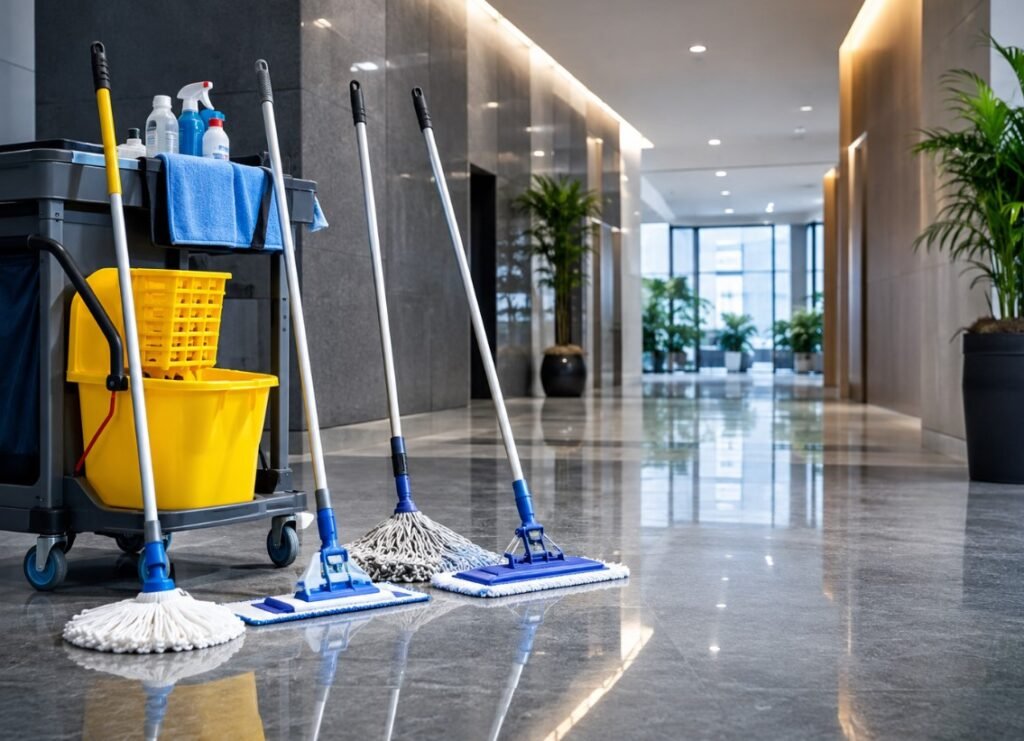
Verify Mop Supplier Capacity and Repeat Specifications
A dependable mop supplier in Pakistan should be able to describe available GSM, widths, refill compatibility, MOQ, packing and delivery time. Repeat orders should match the approved specification as closely as possible, so buyers should retain product codes, dimensions and written quotations. Supplier continuity is particularly important for cleaning contractors and multi-site organizations because changing fittings without notice can create unusable refill stock across several branches.
Finalize the Wet Mop and Dry Mop Purchase Specification
The final purchase specification should state product type, GSM or width, refill or complete set, connection method, handle requirements, quantity, packaging, delivery city and desired delivery date. It should also identify whether alternatives require approval. Sending this information with a quote request enables faster and more accurate comparison. Once approved, store the specification with procurement records so later teams can reorder the same wet mop and dry mop configuration without restarting research.
Wet Mop and Dry Mop Market Price Comparison in Pakistan
| Product Type | Common Specification | Indicative Pakistan Market Range |
| Cotton wet mop refill | 400 GSM | PKR 350–600 per piece |
| Cotton wet mop refill | 450 GSM | PKR 400–700 per piece |
| Heavy wet mop refill | 500 GSM | PKR 475–850 per piece |
| Dry/dust mop set | 24 inch | PKR 1,200–2,200 per set |
| Dry/dust mop set | 36 inch | PKR 1,600–3,000 per set |
| Industrial dry mop set | 60 inch | PKR 2,500–4,500 per set |
| Complete wet or dry mop system | Commercial grade | PKR 1,800–5,500+ per set |
Pricing note: These are indicative retail and wholesale market references. Final rates depend on yarn quality, GSM, frame material, handle, order quantity, tax, freight and delivery city. Request a current quotation before procurement.
Related Products and Helpful Wet Mop Guides
- Shop the 20L single mop bucket with wringer
- Compare the 30L heavy-duty mop bucket with wringer
- View the 46L double mop bucket with wringer
- Explore the 50L dual-chamber commercial mop bucket
- Read How to Choose Wet Mop and Dry Mop for Commercial Floors
- Read Wet Mop vs Dry Mop for Professional Cleaning Teams
- Read the Commercial Mop Maintenance and Refill Replacement Guide
- Read the Mop GSM and Dry Mop Size Buying Guide Pakistan
FAQs About Wet Mop and Dry Mop
Q1. What is the difference between a wet mop and dry mop?
A dry mop removes loose dust, hair and grit without water, while a wet mop uses controlled moisture to loosen and absorb spills, stains and adhered soil. Many commercial teams use the dry mop first and the wet mop second.
Q2. Which wet mop GSM is best for commercial cleaning?
The best GSM depends on floor area, soil level, staff comfort and wringer size. A 400 GSM mop suits lighter routine work, 450 GSM offers balanced capacity, and 500 GSM supports larger or more demanding areas.
Q3. Which dry mop size should I choose?
Choose 24 inch for rooms and narrow routes, 36 inch for corridors and medium open floors, and 60 inch for warehouses or broad industrial areas. Always confirm turning space, storage and refill availability.
Q4. Can I buy only a wet mop refill?
Yes, when the refill attachment matches your existing handle or holder. Confirm socket, clip, fitting and wringer compatibility before ordering so the replacement head can be used without modification.
A5. How often should a commercial mop refill be replaced?
Replace it when yarn or fibres are badly worn, stitching fails, attachment becomes loose, absorbency or dust capture declines, or odour remains after proper laundering. Usage and washing conditions determine the actual schedule.
Q6. How should wet mop heads be stored?
Rinse and wash them according to the approved procedure, then dry them completely in a ventilated area. Store clean refills off the floor and never leave a wet mop standing in dirty bucket water.
Q7. Is a dry mop better than a broom?
A dry mop can cover broad smooth floors and hold fine dust more effectively than pushing it into a pile, but the best tool depends on the debris and surface. Large particles may still need separate collection.
Q8. What affects mop price in Pakistan?
Price changes with GSM, width, yarn and backing quality, frame and handle material, whether the item is a refill or complete set, order quantity, packaging, tax, freight and delivery city.
Q9. Do you supply wet mop and dry mop products in bulk?
Plasticko supports bulk and wholesale enquiries for hotels, hospitals, restaurants, schools, factories, cleaning contractors, facility managers, wholesalers and distributors across Pakistan.
Q10. How can I request a quotation for commercial mops?
Share the required GSM or width, refill or complete set, quantity, delivery city, business type and any colour-coding or packaging needs. This allows the supplier to prepare a more accurate quotation.