
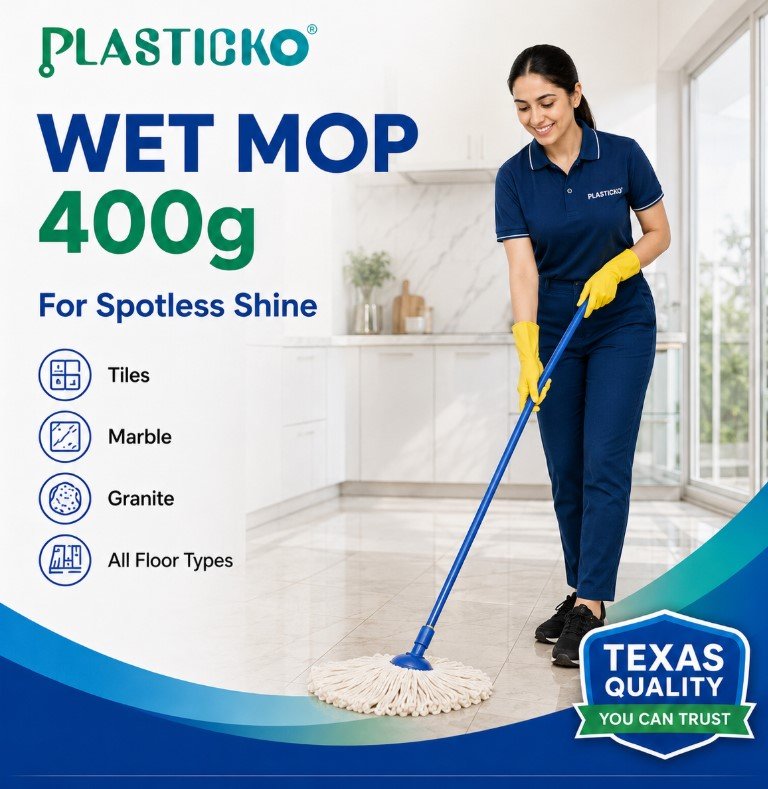
Commercial cleaning teams often need a middle-ground solution between lightweight everyday mopping and heavier intensive floor washing. A Wet Mop 400g sits close to that practical middle point, offering buyers an option for routine commercial cleaning where both floor coverage and comfortable handling matter.
Plasticko currently lists a dedicated Wet Mop 400g product and includes it within its wider Wet Mop category for commercial and institutional buyers.
For procurement managers, the important question is not whether 400g is universally better than another weight. The real question is whether it matches the facility’s floor area, cleaning frequency, staff workload, wringer system and soil conditions.
The Operational Role of a 400g Wet Mop
A mop used professionally can be rinsed and wrung dozens of times during a shift.
For that reason, mop selection should account for repeated handling.
The 400g category can appeal to businesses seeking more working presence than a very light mop while avoiding unnecessary weight for routine tasks.
This makes it relevant to facilities with mixed cleaning environments rather than one extremely specialized application.
A Useful Middle Category for Mixed Facilities
Consider a medium-sized hotel.
The same housekeeping department may need to clean corridors, washrooms, service areas, dining sections and utility spaces.
A balanced mop option can make stock planning simpler when several general-purpose areas require similar cleaning intensity.
Matching Mop Weight with Floor Area
The physical dimensions of the floor should influence purchasing.
A small room generally requires more turning and repositioning. A wide open floor allows longer cleaning passes.
For smaller areas, maneuverability may dominate the decision.
For medium areas, buyers often seek a combination of maneuverability and coverage.
For very large areas, a heavier or wider cleaning system—or mechanical equipment—may sometimes be more efficient.
The 400g option should therefore be evaluated in the context of the complete cleaning route.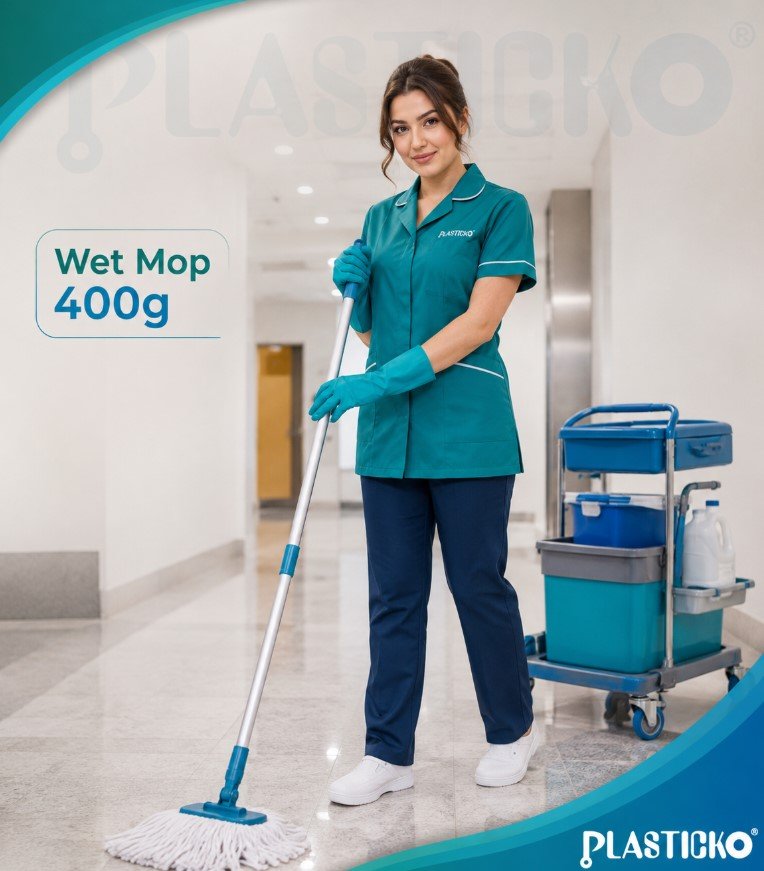
Wet Mop 400g for Hotel Operations
Hotels are strong examples of mixed-use facilities.
Guest-facing floors need a clean appearance, while service areas require durable everyday equipment.
Corridors and Common Areas
Corridors accumulate dust, footwear marks and occasional spills.
A wet mop can be part of scheduled maintenance after dry debris has been removed.
Cleaning during low-traffic periods can help teams work efficiently while reducing disruption.
Washroom Cleaning
Washrooms should normally have dedicated cleaning equipment according to the facility’s hygiene procedures.
Mops used there should not casually move into guest or food-service areas.
Banquet and Event Areas
Event spaces may require rapid turnaround after functions.
The cleaning team needs equipment that can be deployed quickly, cleaned properly and returned to storage before the next event.
Wet Mop 400g for Hospitals and Clinics
Healthcare procurement requires more caution than general commercial cleaning.
A 400g wet mop may be physically capable of cleaning a floor, but suitability for a specific healthcare environment depends on the facility’s infection-control plan, chemical compatibility, zoning rules and any required product standards.
Plasticko itself notes that healthcare and food environments may have stricter requirements and that procurement teams should verify site-specific suitability rather than assuming all general commercial cleaning products can be used everywhere.
This distinction is important for responsible B2B purchasing.
Wet Mop 400g in Educational Facilities
Schools, colleges and universities contain large numbers of different floor zones.
Classrooms, corridors, cafeterias, staff offices and washrooms can all require separate cleaning schedules.
A standardized medium-weight mop can simplify procurement for general floor areas while specialist zones retain dedicated equipment.
Cleaning Between High-Traffic Periods
Educational facilities frequently have short windows between classes or shifts.
Equipment that is ready to deploy and simple to wring can help janitorial teams use those windows effectively.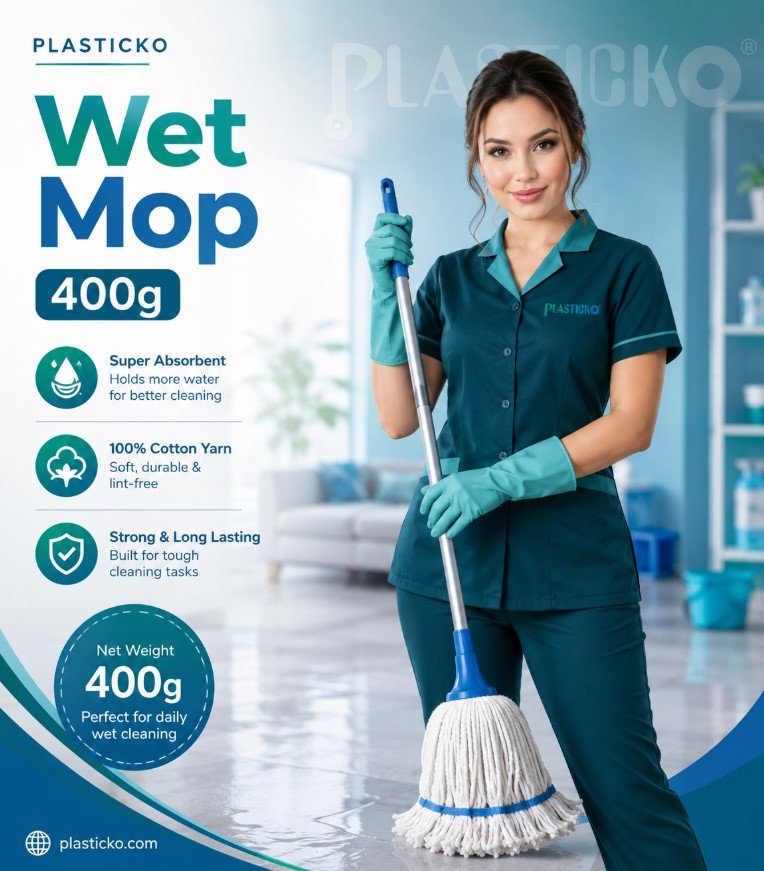
Commercial Cleaning Companies and 400g Mop Standardization
Cleaning contractors often benefit from limiting the number of incompatible tools carried from site to site.
If a 400g wet mop is suitable for several general commercial tasks, a contractor may choose to standardize it across selected accounts.
Standardization can simplify:
Purchasing, spare stock, staff familiarization, compatible handles, bucket selection and replacement planning.
However, site-specific hygiene rules still take priority.
Comparing 350g and 400g Wet Mops
Because the weights are relatively close, buyers may wonder whether the difference matters.
The answer depends on how each mop is constructed and used.
| Evaluation Area | Wet Mop 350g | Wet Mop 400g |
|---|---|---|
| Handling emphasis | Lighter routine work | Balanced routine work |
| Small-area movement | Strong | Strong |
| Medium floor areas | Suitable | Particularly worth considering |
| Working liquid capacity | Product dependent | Product dependent |
| Operator preference | Easier feel for some staff | More substance for some tasks |
| Buying decision | Light-duty focus | General-purpose balance |
Do not treat weight alone as a complete performance specification.
Fiber construction, attachment quality and compatibility also matter.
Why the Mop Bucket Influences Cleaning Efficiency
A mop and bucket should be selected as a system.
If the bucket is difficult to move, too small for the route or incompatible with the mop head, productivity drops.
A proper wringer allows staff to adjust moisture before returning the mop to the floor.
Plasticko currently lists commercial bucket-and-wringer products including a 20L single bucket and larger dual-compartment trolley configurations.
Single Versus Double Bucket Approach
A single-bucket setup may suit compact cleaning routes.
A double-bucket system can help facilities that want separate compartments for cleaning solution and rinse water.
The best option depends on site procedure, floor area and mobility requirements.
Controlling Water on Commercial Floors
More water does not necessarily create a cleaner floor.
Excessive moisture can increase drying time and create operational inconvenience.
The mop should be wrung to the moisture level appropriate for the cleaning method and floor.
Staff should also follow chemical dilution instructions rather than adding extra detergent in the belief that stronger concentration always cleans better.
Overuse can leave residues and increase product consumption.
Pre-Cleaning Before Wet Mopping
One of the simplest ways to improve wet-mopping efficiency is to remove loose dirt first.
Dust, grit, hair, packaging fragments and food crumbs should normally be collected with suitable dry-cleaning tools before wet work begins.
Otherwise, the wet mop becomes overloaded with debris and cleaning solution becomes dirty faster.
Build a Dry-to-Wet Sequence
A practical sequence can be:
- Inspect the area.
- Remove obstacles where permitted.
- Collect loose debris.
- Prepare the correct cleaning solution.
- Position warning signs.
- Wet mop the planned section.
- Rinse and wring at suitable intervals.
- Allow the floor to dry.
- Clean and store equipment.
A consistent method often matters more than small differences in product weight.
Mop Rotation for Multi-Shift Businesses
Facilities operating morning, evening and night shifts should consider equipment rotation.
If one mop is still being washed or dried, another should be available.
This is particularly relevant to hospitals, hotels, airports, factories, restaurants and transport facilities where cleaning cannot simply stop at the end of a conventional office day.
A rotation system can help avoid putting damp, poorly cleaned equipment back into service.
When to Retire a 400g Wet Mop Head
Procurement teams sometimes focus heavily on purchasing but pay less attention to retirement criteria.
A mop should be removed from service when it can no longer be maintained to the required standard.
Indicators include:
Material deterioration, persistent contamination, damaged attachment points, fibers breaking away, reduced absorbency or performance that no longer meets operational expectations.
Documented inspection can improve consistency across larger teams.
Storage Makes a Difference
After cleaning, equipment should be stored so it can dry appropriately and remain separated from dirty supplies.
Avoid leaving mop heads submerged in buckets between shifts.
Storage rooms should be organized so staff can distinguish clean equipment, used equipment and products awaiting replacement.
Good organization reduces accidental reuse of unsuitable tools.
B2B Purchasing Factors for Wet Mop 400g
A wholesale order should be based on more than the product name.
Order Volume
Determine how many mops are actively in use, how many are being processed or dried and how many backups are required.
Frequency of Cleaning
A business cleaning once each evening has different replacement needs from a facility running three shifts.
User Team Size
More cleaners working simultaneously means more active equipment.
Floor Characteristics
Smooth hard floors, textured surfaces and specialist materials may require different cleaning approaches.
Compatibility
Confirm the mop works with the intended handle, clip and wringer.
Supply Continuity
For repeat commercial purchasing, consistent access to replacement stock matters.
Plasticko’s wholesale service currently targets hotels, hospitals, restaurants, laboratories, schools, offices, factories, cleaning companies, wholesalers and other procurement teams.
Evaluating Total Cost of Ownership
Suppose Buyer A receives the lowest unit price but experiences frequent incompatibility or replacement issues.
Buyer B pays slightly more but receives a suitable, consistently available product that fits existing handles.
The second option can be operationally cheaper.
Commercial buyers should therefore compare:
| Cost Element | Impact |
|---|---|
| Unit cost | Initial purchase expense |
| Freight | Delivered cost |
| Compatible hardware | Possible additional investment |
| Replacement frequency | Long-term consumption |
| Staff productivity | Labor impact |
| Supply consistency | Risk of downtime |
| Bulk packaging | Storage and distribution efficiency |
This is a stronger procurement approach than choosing on headline price alone.
Wet Mop 400g for Wholesale and Distribution
Distributors purchasing mops have different needs from end users.
They must consider the range their customers request, packaging, repeatability and inventory turnover.
A 400g product can occupy a useful general-purpose position within a broader mop portfolio.
Wholesalers may also stock adjacent weights so customers can select according to their own cleaning requirements.
Plasticko’s current Wet Mop line spans multiple weight options, supporting that type of range-based procurement.
When Should Buyers Choose Another Mop Weight?
A 400g mop should not be forced into every cleaning task.
Choose a lighter alternative where staff need maximum maneuverability for smaller routine sections.
Compare heavier options where large floor areas, intensive wet cleaning or higher liquid capacity are priorities.
Specialist environments should use equipment selected according to their own technical requirements.
The best commercial cleaning program uses different tools where differences are operationally justified.
Final Procurement Recommendation
The Wet Mop 400g can be a strong general-purpose option for facilities seeking a balance between everyday handling and practical commercial floor coverage.
Hotels, educational institutions, offices, restaurants, facility-management companies and cleaning contractors can evaluate it for medium-duty cleaning routes where neither the lightest nor the heaviest mop is necessary.
Before ordering, document the number of cleaning zones, staff working per shift, compatible mop hardware, bucket system, expected replacement frequency and delivery requirement.
A buyer who evaluates the complete cleaning system—not simply mop weight—is more likely to select equipment that performs consistently over time.
FAQs About Wet Mop 400g
1. What is a Wet Mop 400g?
It is a commercial wet-mop option sold within a 400g weight category and designed for routine floor-cleaning applications.
2. What type of business can use a 400g wet mop?
Potential users include hotels, offices, restaurants, educational facilities, institutions, cleaning contractors and other commercial premises where the product matches the cleaning procedure.
3. Is a 400g mop heavier than a 350g mop?
Yes, based on the listed weight categories, although actual working feel also depends on construction and absorbed liquid.
4. Is Wet Mop 400g suitable for hospitals?
It may be suitable for specific tasks only if it meets the healthcare facility’s infection-control, material, chemical and procurement requirements.
5. Should I choose 400g or 650g?
Choose according to area, workload and staff handling requirements. A 400g mop generally occupies a more moderate weight category, while a 650g option is worth comparing for heavier cleaning demands.
6. Does the mop need a special bucket?
It requires a bucket and wringer that are physically compatible with its size and intended cleaning workflow.
7. How often should commercial mop heads be replaced?
There is no universal schedule. Replace them according to condition, hygiene standards, usage frequency and cleaning performance.
8. Can Wet Mop 400g be purchased for wholesale supply?
Commercial and wholesale buyers can request quotations based on quantity and delivery requirements.
9. Why should businesses keep spare mop heads?
Spare inventory allows cleaning to continue when active mop heads are being cleaned, dried, damaged or replaced.
10. What should a procurement team check before ordering?
Check specification, quantity, attachment compatibility, bucket and wringer requirements, intended facility type, replacement needs, delivery destination and current quotation.