
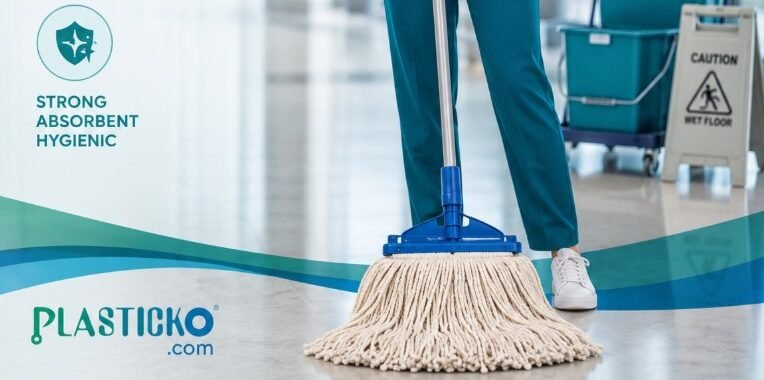
Professional floor care depends on more than cleaning chemicals and buckets. The mop itself determines how efficiently a cleaning team can cover flooring, manage moisture and maintain consistent standards throughout a facility. A Kentucky Mop is a practical choice for commercial environments where staff repeatedly wash medium and large floor areas during scheduled cleaning rounds.
Hotels, restaurants, offices, educational buildings, healthcare facilities, factories and professional cleaning contractors all face different floor-care challenges. Some locations require frequent removal of tracked-in soil, while others need controlled wet cleaning at specific times of the day. Selecting an appropriate mop system therefore requires buyers to consider cleaning frequency, floor type, compatible handles, wringing method and replacement requirements rather than purchasing on price alone.
For procurement teams, the objective is simple: choose equipment that supports everyday cleaning while remaining practical to maintain and replace.
What Makes a Kentucky Mop Suitable for Professional Cleaning?
A Kentucky-style mop is commonly associated with traditional commercial wet-floor cleaning where an absorbent mop head is attached to a compatible holder or clip. Its design is useful for teams that need straightforward equipment that staff can quickly prepare, rinse, wring and return to service.
Unlike small household mops designed for limited areas, commercial mopping systems are frequently used repeatedly throughout a shift. This makes mop-head compatibility, absorbency, handling and replacement planning important purchasing considerations.
The correct mop should allow cleaning staff to move comfortably between corridors, washrooms, kitchens, service areas and general-purpose floors without making the workflow unnecessarily complicated.
Focus on Workflow Rather Than Mop Size Alone
A larger or heavier mop is not automatically the better option. Cleaning managers should first determine how the equipment will be used.
For example, a hotel housekeeping team working on selected service areas may have different requirements from a contractor cleaning an entire commercial building. A restaurant may prioritize fast spill recovery, while a warehouse may prioritize larger-area coverage.
Choosing according to the cleaning route can improve both productivity and user comfort.
Kentucky Mop Applications Across Commercial Facilities
One reason the Kentucky Mop remains relevant for professional cleaning is its versatility. It can form part of routine floor-maintenance programs in a wide range of facilities.
Hotels and Hospitality Properties
Hotel floors must remain presentable throughout guest-facing and back-of-house areas. Lobbies, service corridors, staff sections and washroom zones may all need wet cleaning at different frequencies.
A structured mop program allows housekeeping supervisors to allocate equipment according to area and shift. Mop heads should be washed, dried and replaced according to the hotel’s hygiene procedures.
Restaurants and Food-Service Operations
Restaurants frequently deal with water, food residues and routine floor contamination. Back-of-house areas can require repeated cleaning during operating hours.
Cleaning teams should use suitable chemicals for the floor surface, place wet-floor warning signs and avoid leaving excessive water where employees or customers walk.
Offices and Corporate Buildings
Office floors may need lighter maintenance than industrial environments, but entrances, cafeterias and washrooms often require regular wet cleaning.
A dependable commercial mop can help janitorial teams manage these areas without relying on complicated equipment.
Hospitals and Healthcare Facilities
Healthcare environments require controlled cleaning procedures, and the mop is only one part of the system.
Facilities should follow their own infection-control policies, chemical requirements and zoning procedures. Equipment used in clinical areas should never be assumed suitable merely because it is marketed for general commercial cleaning.
The Role of Absorbency in Wet Floor Cleaning
Absorbency influences how a mop collects and distributes liquid during cleaning. However, maximum water retention is not always desirable.
An excessively saturated mop can leave unnecessary moisture behind, increasing drying time. An inadequately wet mop may not distribute cleaning solution effectively.
Professional cleaning teams therefore need a controlled cycle:
Apply the appropriate cleaning solution, work the selected floor area, rinse the mop correctly, remove excess liquid through a compatible wringer and repeat the process according to the site cleaning plan.
This controlled approach is more important than simply soaking the mop with as much water as possible.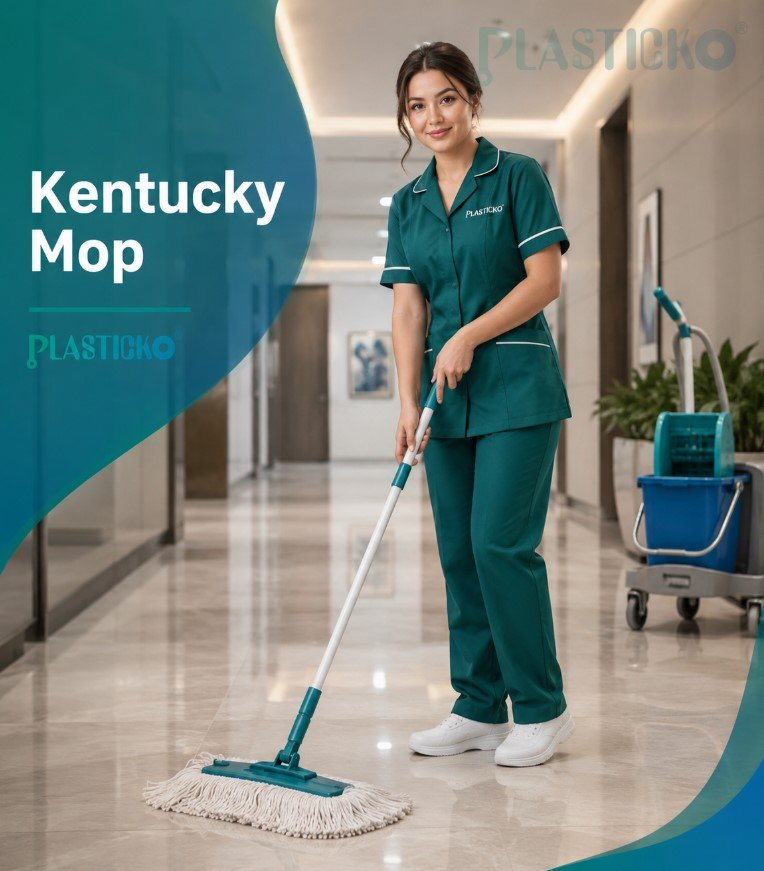
Kentucky Mop and Wringer Systems
A mop performs best when paired with equipment that supports its intended workflow.
Commercial facilities commonly combine wet mops with mop buckets and wringers. A wringer helps employees control moisture without manually twisting or squeezing the mop head.
For larger operations, mobile mop buckets or trolley-based cleaning systems can reduce repeated carrying of water.
Plasticko currently offers commercial mop buckets and wet-mop-related cleaning products as part of its wider B2B cleaning range.
Why Controlled Wringing Matters
Controlled wringing can support:
- More consistent floor moisture
- Reduced dripping while moving
- Easier cleaning-solution management
- Faster transition between cleaning zones
- Less need for employees to manually handle saturated mop heads
A wringer does not replace good cleaning technique, but it can make routine floor-care processes more manageable.
Kentucky Mop Versus Lightweight Wet Mops
Buyers often compare mop systems based on weight or appearance. A better comparison is to consider the task.
A lighter wet mop can be practical for smaller cleaning zones, lighter daily soil and staff who prioritize easy handling. A traditional Kentucky-style setup may be preferred where a business wants a familiar commercial cleaning system for repeated washing and rinsing.
Neither is universally superior.
The correct choice depends on the surface, cleaning area, staff workflow, bucket system and frequency of use.
Planning a Commercial Cleaning Route
Before purchasing mops in bulk, facility managers should map the cleaning route.
Identify:
Area 1: Entrances and reception flooring
Area 2: Washrooms
Area 3: Staff and service areas
Area 4: Kitchens or food-service zones
Area 5: Corridors and general floors
Area 6: Restricted or specialist areas
This process helps determine how many mops are actually needed and whether equipment should be separated by department or application.
Avoid Using One Mop Everywhere
Using the same mop across every area can create operational and hygiene problems.
A better system is to assign equipment according to the facility’s internal cleaning policy. Color identification, storage labels or clearly separated mop stations can make the process easier for staff to follow.
How Often Should Kentucky Mop Heads Be Replaced?
There is no universal replacement interval because usage conditions differ.
Inspect mop heads regularly for:
Frayed or damaged fibers, persistent odor after washing, material breakdown, poor absorbency, contamination that cannot be properly removed or attachment damage.
A heavily used restaurant cleaning mop may require replacement sooner than equipment used occasionally in an office.
Businesses should therefore base replacement on inspection and performance rather than an arbitrary calendar date.
Cleaning and Storage Practices That Extend Mop Usability
A commercial mop should not remain wet in a bucket between cleaning shifts.
After use, employees should follow the organization’s approved cleaning process. Depending on the mop material and site requirements, this may include proper rinsing or laundering, removal of soil and chemical residue, controlled drying and storage in a ventilated location.
Never return a visibly contaminated mop to general storage.
Proper storage can also help prevent unpleasant odor and unnecessary material deterioration.
Buying Kentucky Mops for B2B Procurement
Commercial procurement is different from buying a single household cleaning product.
When requesting a quotation, businesses should prepare clear requirements.
Quantity Required
Estimate current use plus replacement stock. Buying exactly the number being used today may create shortages when damaged or worn mop heads need replacing.
Compatible Hardware
Confirm whether the mop works with your current handles, clips, holders, buckets and wringers.
Intended Application
Tell the supplier whether the equipment will be used in hotels, offices, restaurants, institutions, factories or another type of facility.
Delivery Location
Freight and supply planning can differ depending on the city and quantity.
Recurring Requirement
Wholesalers, cleaning contractors and multi-branch businesses should discuss repeat supply instead of treating every purchase as an isolated order.
Plasticko’s current wholesale service is specifically structured around bulk cleaning and janitorial procurement for commercial buyers across Pakistan.
Evaluating Kentucky Mop Cost Beyond Unit Price
The cheapest mop is not necessarily the lowest-cost option over time.
Commercial buyers should consider:
| Procurement Factor | Why It Matters |
|---|---|
| Mop-head durability | Influences replacement frequency |
| Absorbency | Affects wet-cleaning workflow |
| Handle compatibility | Prevents unnecessary hardware purchases |
| Wringer compatibility | Helps control moisture |
| Replacement availability | Reduces downtime |
| Bulk quantity | May affect commercial quotation |
| Delivery requirement | Influences landed purchasing cost |
Rather than comparing only unit price, calculate the expected cost of keeping an entire cleaning team operational.
Kentucky Mop Requirements for Cleaning Contractors
Cleaning contractors face a particular challenge because their equipment may be used at several client locations.
Standardization can simplify procurement.
Using compatible mop handles, buckets, wringers and replacement heads across multiple sites reduces the number of different components a contractor has to keep in stock.
Contractors should also document where equipment is used to prevent accidental transfer between incompatible cleaning zones.
Building a Better Floor-Care System
The mop should be treated as one component of a broader floor-care system.
That system may include:
A commercial mop bucket, wringer, appropriate handle, cleaning chemicals, wet-floor signs, personal protective equipment, storage racks and replacement mop heads.
When all components are selected together, staff are less likely to improvise with incompatible products.
When a Kentucky Mop Is a Practical Choice
A Kentucky Mop can be a strong option when a facility needs conventional wet-floor cleaning, repeated rinse-and-wring cycles, straightforward replacement and equipment that cleaning staff can easily understand.
For extremely large open floors, mechanized equipment may sometimes be more productive. For small rooms, a lighter system may be adequate.
Procurement decisions should therefore begin with the actual cleaning area rather than a product name alone.
Final Buying Recommendation for Commercial Buyers
Choose a Kentucky Mop according to the cleaning route, floor surface, compatible handle and wringer system, staff workload and expected replacement frequency.
Hotels, restaurants, offices, institutions, cleaning companies and wholesalers should also consider maintaining spare mop heads so worn units can be replaced without interrupting cleaning schedules.
For bulk purchasing, prepare the required quantity, intended application and delivery city before requesting a commercial quotation. This makes it easier for a supplier to recommend an appropriate combination of mop heads, handles and cleaning accessories.
FAQs About Kentucky Mops
1. What is a Kentucky Mop used for?
A Kentucky Mop is primarily used for wet floor cleaning in commercial, institutional and professional cleaning environments where staff need a practical mop-and-bucket workflow.
2. Can Kentucky Mops be used in hotels?
Yes, they can be used for suitable hotel floor-cleaning areas when incorporated into the property’s cleaning and hygiene procedures.
3. Is a Kentucky Mop suitable for restaurants?
It can be suitable for routine restaurant floor cleaning. Food-service businesses should use appropriate cleaning chemicals and keep equipment separated according to their hygiene procedures.
4. Does a Kentucky Mop need a wringer?
A compatible wringer is highly useful because it helps remove excess water and provides more controlled moisture during floor cleaning.
5. How many Kentucky Mops should a business order?
The number depends on cleaning zones, staff size, shift frequency and replacement requirements. Multi-area facilities should consider spare stock as well.
6. How should a Kentucky Mop be stored?
After proper cleaning, allow it to dry according to the manufacturer’s and facility’s instructions and store it in a clean, ventilated location rather than leaving it submerged in dirty water.
7. When should the mop head be replaced?
Replace it when the fibers become excessively worn, damaged, difficult to clean, poorly absorbent or otherwise unsuitable for hygienic use.
8. Can cleaning contractors purchase Kentucky Mops in bulk?
Yes. Commercial cleaning contractors often benefit from bulk procurement and standardized replacement stock.
9. Can one Kentucky Mop be used throughout an entire building?
That is generally not ideal. Facilities should separate equipment according to their cleaning zones and hygiene procedures.
10. What should buyers confirm before ordering?
Confirm quantity, mop-head construction, handle or clip compatibility, intended use, replacement availability, delivery destination and current commercial quotation.